
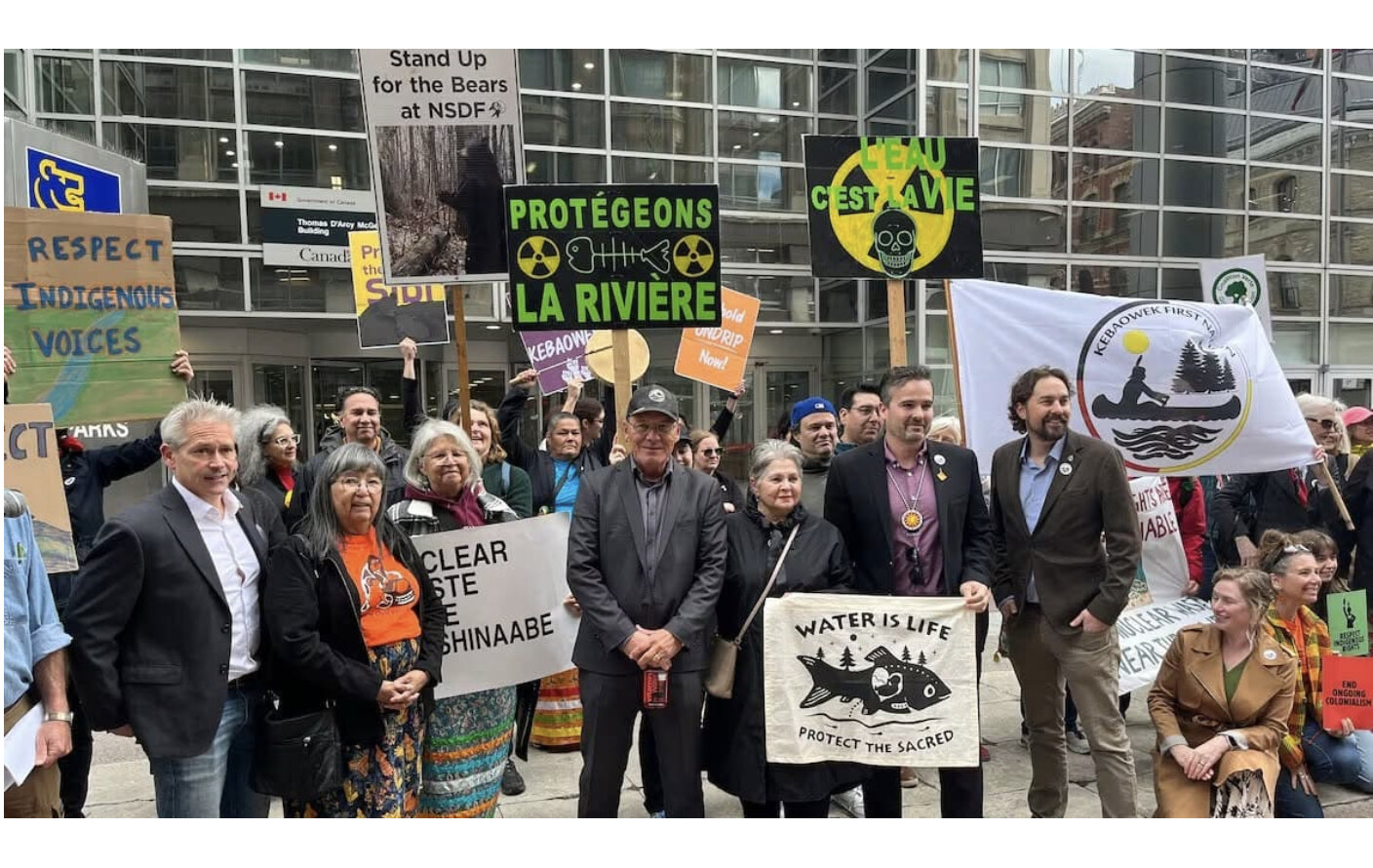
The proposed radioactive waste disposal site in Chalk River remains a concern in the Outaouais region. Photo: École d’été citoyenne
The Chalk River Radioactive Waste Repository Project Continues to Cause Concern in the Outaouais
Drazen Seslija
The Near-Surface Waste Management Facility (NSWMF) project at Chalk River Laboratories is once again raising concerns among residents of the Outaouais region and First Nations representatives, particularly due to the site’s proximity to the Ottawa River.
Located about 180 kilometers upstream from Gatineau, the project involves the construction of a facility designed to store up to one million cubic meters of low-level radioactive waste. According to the Canadian Nuclear Safety Commission (CNSC), the facility would take the form of an above-ground mound and would include, among other features, systems for collecting leachate and detecting leaks. The project was authorized by the CNSC in January 2024.
However, the case saw a new legal development this year. On May 28, 2026, the Federal Court of Appeal dismissed Canadian Nuclear Laboratories’ appeal and ordered the federal government to reconsider its decision regarding the permit issued under the Species at Risk Act. The court also concluded that the federal minister had not sufficiently explained his decision to authorize the project’s impacts on protected species.
It is against this backdrop that representatives of First Nations and resident groups will gather on Saturday, September 26, at the Community Center at 361 Boulevard De Lucerne, in Gatineau. The meeting, organized as part of the École citoyenne at the Université du Québec en Outaouais, will begin at 11 a.m. and end at 3 p.m.
Justin Roy, a council member of the Kebaowek First Nation, will take part in the event alongside scientist Ole Hendrickson and activist Chantal Pelletier. Discussions will focus, among other topics, on the Chalk River project, radioactive waste, and concerns raised by participants regarding the protection of the environment and the land.
A water ceremony will also be held on the banks of the Ottawa River, led by Verna Polson, Grand Chief of the Algonquin Anishinabeg Tribal Council. An exhibition of Indigenous artwork and a meal are also planned before the discussion, which will take place from 1 p.m. to 3 p.m.
The meeting is the first of two events dedicated to exploring a so-called “just” energy transition, from the local to the global level. The event is free and open to residents.