
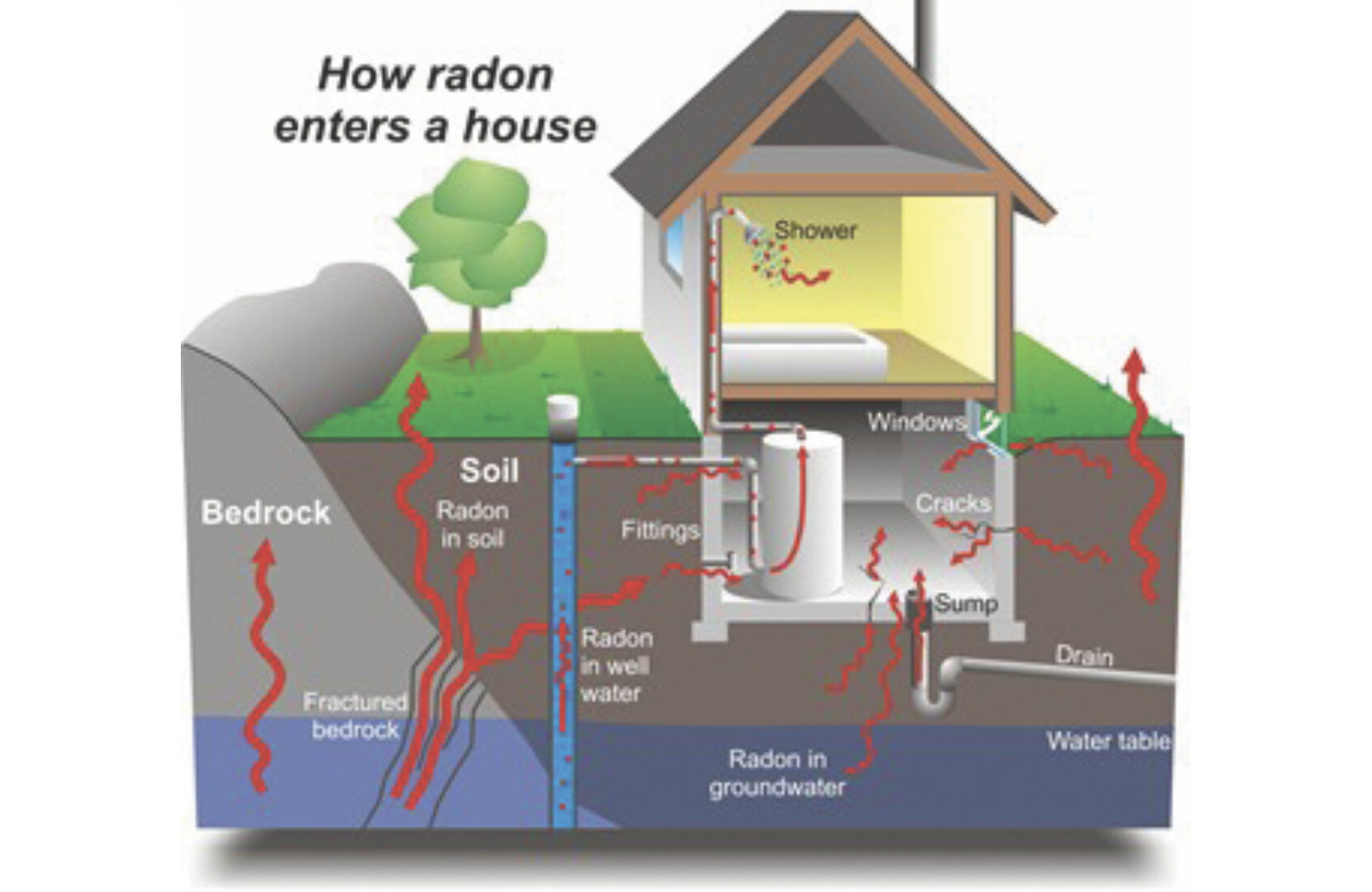
Health officials are urging residents to test their homes for radon, an invisible gas that can accumulate indoors and increase lung cancer risk, noting that kits are widely available and testing is the only way to know if levels are elevated. Photo: Courtesy of the Municipality of Chelsea
Radon testing recommended for local homes
Tashi Farmilo
Quebec health authorities are urging residents to test their homes for radon this winter, warning that the naturally occurring gas can build up indoors and increase the risk of lung cancer over time.
Radon is a colourless, odourless gas released from soil and rock. It can seep into houses through cracks in foundations, gaps around pipes and other small openings. Because it cannot be seen or smelled, testing is the only way to know whether levels inside a home are elevated.
According to Health Canada, radon is the leading cause of lung cancer among non-smokers and the second leading cause overall. Provincial officials say exposure can occur in any type of home, whether new or old, urban or rural.
The ministère de la Santé et des Services sociaux du Québec advises homeowners and tenants to carry out a long-term test, ideally during the colder months when windows and doors are kept closed. Longer tests provide a more accurate picture of average indoor levels.
The City of Gatineau says radon is considered a national public health issue that falls primarily under provincial and federal jurisdiction rather than municipal authority. It notes that responsibility for information and monitoring of residential radon levels rests with the governments of Quebec and Canada, and directs residents to Health Canada, Quebec’s health ministry and the Centre intégré de santé et de services sociaux de l’Outaouais for guidance on testing and prevention.
Test kits are widely available in Quebec. Residents can order them online through the Quebec Lung Association or purchase them from suppliers such as AccuStar Canada. CAA Quebec also offers radon test kits to members. Many hardware stores carry approved kits as well.
After completing the test, homeowners mail the device to a certified laboratory and receive results by email or mail. If levels are found to be high, certified mitigation professionals can install systems designed to safely vent radon from beneath the home to the outdoors.
Public health officials stress that no region of Quebec is considered radon-free and that even neighbouring homes can have very different readings, depending on soil conditions and construction. Information on testing, mitigation professionals and financial assistance is available from Quebec’s public health authorities at: www.quebec.ca/habitation-territoire/milieu-de-vie-sain/radon-domiciliaire.