
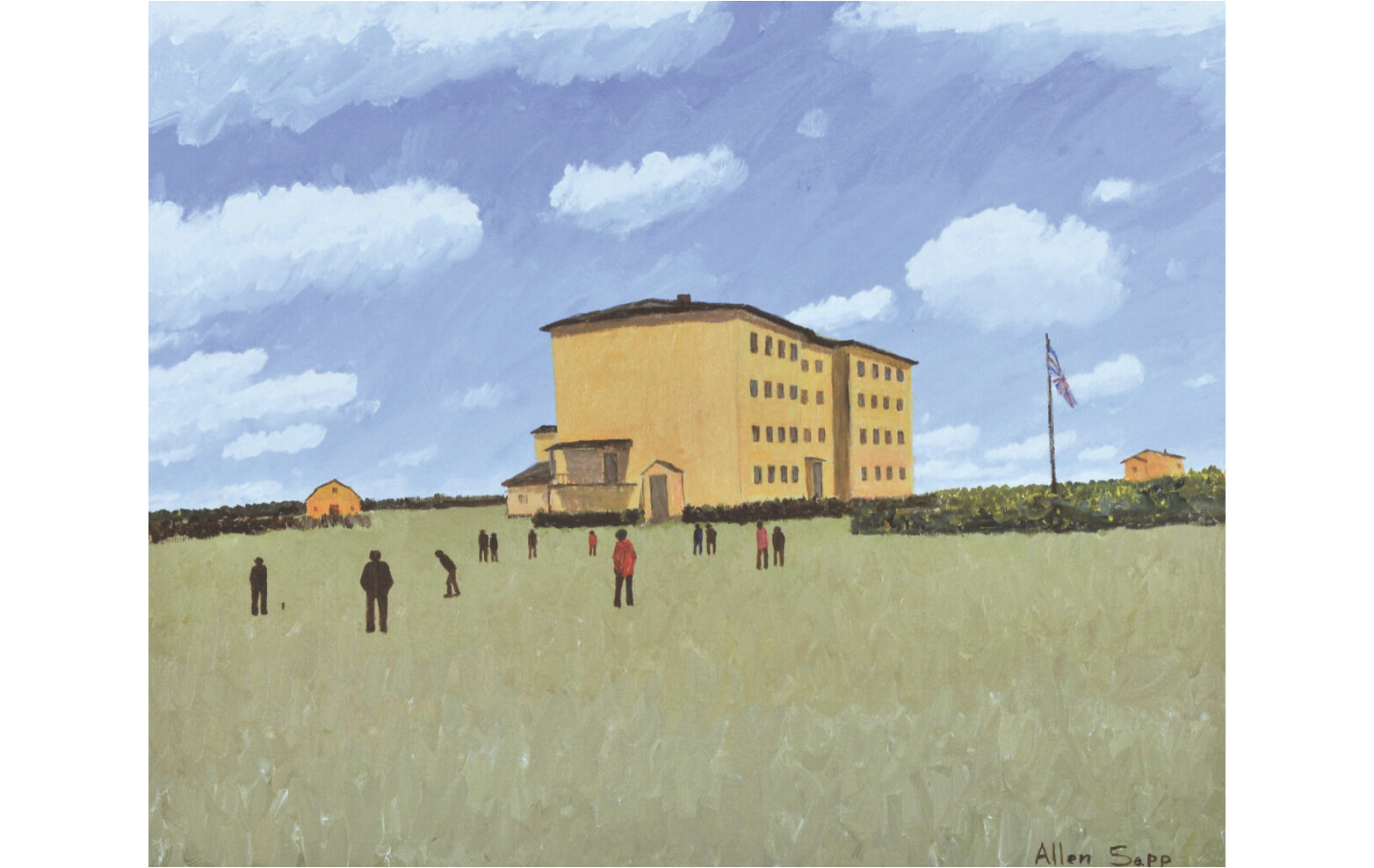
A free online book by curator Gerald McMaster examines how Indigenous artists have borne witness to the residential school system and its lasting legacy, through 70 works that include Allen Sapp's 1988 painting Recess at Onion Lake School. Photo; Courtesy of The Canadian Art Institute (CAI)
Indigenous artists bear witness to residential school legacy in new free book
Tashi Farmilo
A new bilingual online book on how Indigenous artists have answered the residential school system, and the hurts and harms they caused that have endured generations, was published online on September 29 by the Art Canada Institute to mark the National Day for Truth and Reconciliation on September 30. Written by curator and artist Gerald McMaster, Art, Truth and Reconciliation honours survivors, the children who never came home, and their families and communities.
McMaster, a Nêhiyaw (Plains Cree) citizen of the Siksika Nation, once worked at the Canadian Museum of Civilization, now the Canadian Museum of History, in Gatineau. He has also held posts at the Art Gallery of Ontario and the Smithsonian's National Museum of the American Indian, and led the Wapatah Centre for Indigenous Visual Knowledge at OCAD University.
The book is arranged as a dialogue between generations: drawings made by children inside the schools, works by survivors, and pieces by younger artists who confront the system's long aftermath. The 70 works include Rebecca Belmore's Apparition, Kent Monkman's The Scream, Allen Sapp's Recess at Onion Lake School, Adrian Stimson's Sick and Tired and Lawrence Paul Yuxweluptun's Indian Residential School, Leaving the Shallow Graves and Going Home. McMaster reads them as testimony and memory, and as acts of resilience and healing, and connects them to the Calls to Action of the Truth and Reconciliation Commission of Canada.
The project took about two years and was personal, The Canadian Press reported. McMaster grew up on the Red Pheasant Cree Nation in Saskatchewan, where several relatives attended residential or day schools. When he began his research, he found plenty written about the schools and about Indigenous art, but little that joined the two on a broad scale.
Sara Angel, the institute's founder and executive director, credited McMaster with having "profoundly renewed the study of Indigenous art in Canada" over several decades. She said the book fits the institute's aim of making writing on Canadian art free to everyone, an effort that has produced more than 70 free titles.
"These works remind us that reconciliation is not a destination, but an ongoing responsibility," McMaster said.
The book is available at artcanada.com/fr/livres/livres-en-ligne/art-verite-et-reconciliation.