
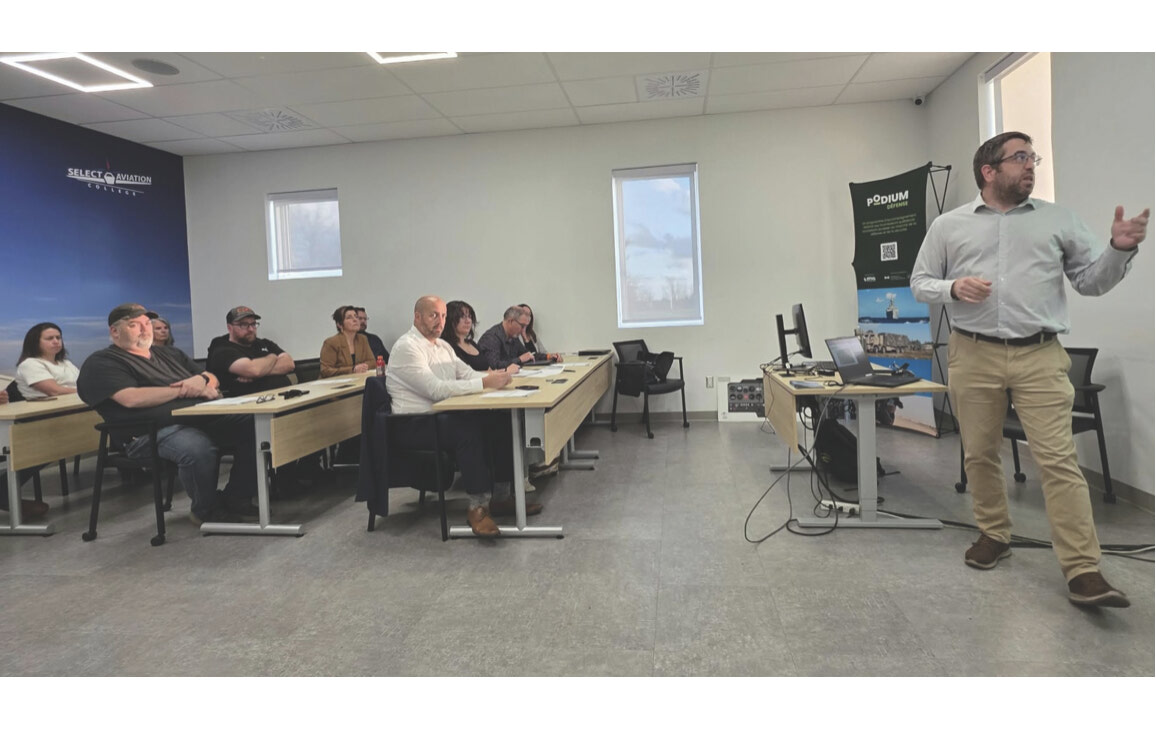
STIQ adviser Pierre-Laurent Boudrias told Gatineau manufacturers at a November 5 workshop at the Gatineau-Ottawa Executive Airport that Canada’s defence spending surge offers lucrative long-term contracts, but only to firms willing to spend years building the quality systems, security clearances and supply chain controls that military buyers demand. Photo: Tashi Farmilo
Gatineau manufacturers told the defence boom has a steep price of entry
Tashi Farmilo
Canada’s surge in military spending could open a lucrative market for Outaouais manufacturers, but only those willing to overhaul how they run their shops will get through the door, a Quebec manufacturing adviser told local business owners on November 5 at a workshop at Collège Sélect Aviation, on the grounds of the Gatineau-Ottawa Executive Airport. ID Gatineau and Sous-traitance industrielle Québec (STIQ) organized the session to help regional firms judge whether they are ready to compete for the military contracts Ottawa has promised.
Pierre-Laurent Boudrias, a mechanical engineer, spent 15 years managing factories before joining STIQ nearly a decade ago, including one plant that made the containers used to ship mortar rounds, grenades, bombs and missiles. He told the room he learned that market largely on the job.
Under the federal Defence Industrial Strategy, released in February, Ottawa expects to spend about $180 billion on military equipment over the next 10 years, plus another $290 billion on related capital projects, and wants Canadian companies to win 70 per cent of that business, up from about a third today. Canada met NATO’s target of spending two per cent of its economic output on defence in 2025 and has pledged to reach five per cent by 2035.
Boudrias urged business owners to first ask whether they really need to pursue it. Defence is not one market but many, he said, and a firm building weapons detection systems faces requirements that a contractor installing a stair railing on a military base never will. Because meeting the strictest standards eats up time, money and staff, a company should start by deciding where it fits, which buyers it wants to reach and what those buyers will expect.
He described a client he did not name, a 65-employee maker of plastic and composite parts whose customers include bus and rail manufacturers such as Volvo, Prévost and Alstom. With its American sales slowing, the company was eyeing defence work to steady its revenue. A STIQ assessment found it reasonably strong at business development but lacking almost everything else a military buyer would ask for. It had no ISO certification and no formal quality system, and its security consisted of a visitor sign-in sheet and a badge, with the doors left open in summer.
“Defence doesn’t just buy the product, it buys the assurance that the product will work once it’s in the field,” Boudrias said. “There’s nothing worse than being in the middle of combat and having your equipment give out.”
In the nearly 300 Quebec plants he has visited, he often finds careful, skilled workers who catch defects through inspection. Military buyers want more. “The military wants to go a notch further,” he said. “So I can’t count on the individual. I have to count on a system. So I have to be able to demonstrate my system.”
Such a system reaches from the first conversation with a client to after-sales service. It requires documented procedures, inspection and control plans, statistical studies showing that machines hold their tolerances, and records that can trace every part and prove every claim. On the shop floor, only workers trained and certified on an approved process may run the machine. Buyers rarely bend on ISO certification, Boudrias noted, and STIQ requires it before a company can join its Podium Défense program.
Participants who had already made the leap in aerospace and automotive work agreed, and one said that once a company masters the method, it ends up using it in every market it serves. Firms that certify only to land a single contract tend to struggle, Boudrias said, while those that make the discipline part of their culture often earn back about twice what it cost them. He described the change as a move from running a workshop to practising professional management, one that takes a year or two.
“You have to understand that putting this in place doesn’t happen on its own,” he said. “If you tell yourself you’ll do it alone, with no support, forget it. You’re not headed in the right direction.”
Companies that handle sensitive military goods or technical data must also register with the federal Controlled Goods Program, which involves appointing a designated official, restricting physical and digital access, and screening the employees who need it. Only one person in the room said their company was registered. Boudrias likened registration to a driver’s licence that goes unchecked until the day an officer asks to see it. “We don’t write procedures just to have them,” he said. “We write them because they’ll have to be deployed.”
The new federal cyber certification for defence suppliers has three tiers. At the entry tier, companies grade themselves each year on 13 basic security measures, while the next tier, for work involving sensitive defence data, brings in an accredited outside auditor every three years. Boudrias estimated that reaching the second tier could cost a small firm about $100,000, with no guarantee of a contract, and advised most newcomers to start at the entry tier and negotiate with prime contractors from there.
For most small and mid-sized manufacturers, the way in is not a direct sale to the Canadian Armed Forces but a place further down the supply chain, making parts or assemblies for large contractors. Any firm that lands a federal defence contract owes Canada an equal amount of economic activity in return, and Ottawa now counts work given to smaller Canadian businesses at twice its value toward that obligation. That, Boudrias said, explains why foreign defence giants have been knocking on the doors of Quebec suppliers and research labs.
Canada chose Germany’s TKMS in July as its preferred builder for the navy’s new submarines, and each boat will need piping, crew berths and thousands of other components made by smaller firms. Even so, Boudrias advised companies against staking everything on a single program.
A defence contractor must also guarantee that every material it buys stays consistent and compliant for the life of a contract, which calls for an approved supplier list, regular performance reviews, inspection on arrival and the ability to trace each batch into finished products. That is a job for a purchasing professional, not a clerk who issues orders, and his composite-maker client was moving purchasing out of its engineering department and into the hands of trained buyers.
Podium Défense can cover as much as $60,000 of a company’s costs, paying for readiness diagnostics and outside experts. Boudrias also encouraged firms to seek out prime contractors at industry events, though the Canadian Defence and Security Market Symposium, which STIQ and Aéro Montréal are holding on November 12.
After the session, participants stayed on for ID Gatineau’s fourth annual manufacturers’ 5 à 7 in the Aéroparc sector, organized with STIQ, Export Outaouais and Sélect Aviation.
Breaking into the market typically takes about two years, Boudrias said, and a company may need its certifications in hand today for work that will not pay for another five. “It pays,” he said. “When you’re in, it pays. It’s the long-term relationship.”