
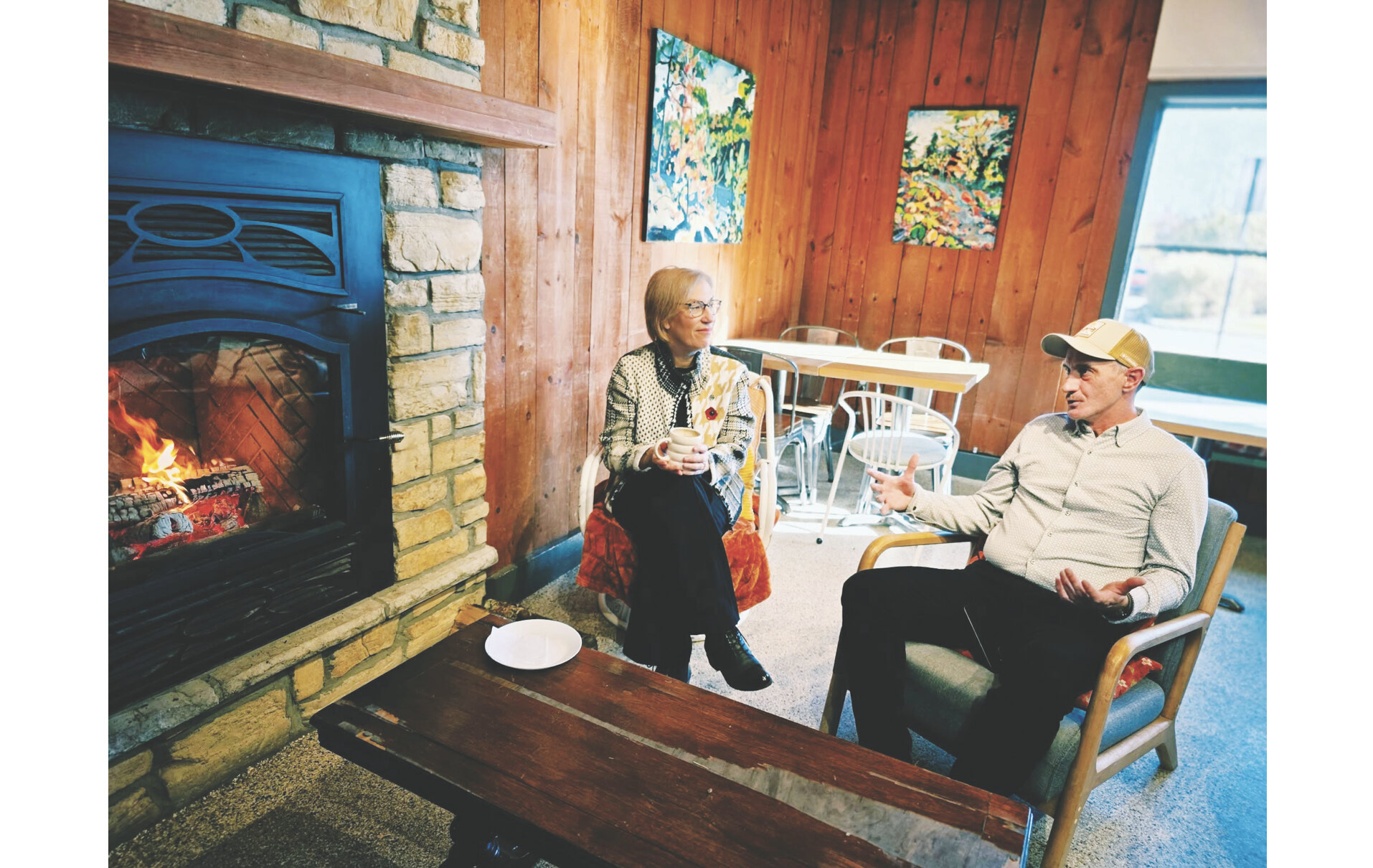
Pontiac-Kitigan Zibi MP Sophie Chatel and CPAWS-OV executive director John McDonnell are urging the Senate to pass Bill S-229, the 15th attempt to give Gatineau Park legal protection, as a new poll shows 82 per cent of Outaouais residents back the bill. Photo: Tashi Farmilo
Fifteenth try to protect Gatineau Park in law rests with the Senate
Tashi Farmilo
Gatineau Park could finally gain legal protection this fall if the Senate moves quickly, Pontiac-Kitigan Zibi MP Sophie Chatel and the Ottawa Valley chapter of the Canadian Parks and Wilderness Society said on October 27 at the Relais plein air du parc de la Gatineau. They called on senators to complete their review of Bill S-229 and send it to the House of Commons, so that the park can no longer be carved up and sold off.
Chatel, parliamentary secretary to the minister of veterans affairs and associate minister of national defence, appeared alongside John McDonnell, executive director of CPAWS-OV, a chapter founded in 1969 in response to threats to the park. Their message was blunt. Nearly nine decades after its creation in 1938, Gatineau Park has no protection in law. Its boundaries appear only in an NCC master plan that carries no legal weight. Because the federal government owns the land outright, the minister responsible can give parts of it away by order in council without Parliament ever weighing in.
“It has zero protection. None,” Chatel said.
S-229 would amend the National Capital Act to change that. The park’s boundaries would be written into law, and shrinking them afterward would require an act of Parliament, apart from narrow exceptions such as land needed for public health-care facilities or other public infrastructure. The NCC would have to make the park’s ecological integrity its first priority, ahead of public use. The sale of public land inside the park would be banned, with limited exceptions, and the commission would have to work more closely with the Algonquin Anishinabeg Nation and the surrounding municipalities.
“I think it’s a very good bill,” McDonnell said, noting that it would finally recognize the park’s boundaries and put nature first.
The Senate Committee on Energy, the Environment and Natural Resources has held the bill since April. McDonnell said senators are expected to finish their review within a week or two, and that with the government’s support the bill should move swiftly through the Commons. CPAWS-OV also released a poll at the event in which 82 per cent of 400 Outaouais residents, surveyed in August by Redfern Research, said they favoured its passage. McDonnell summed up the results in two words: “overwhelming support.”
This is the 15th attempt to give the park legal standing. Chatel said this one started in the Senate because the Commons offered no realistic path. After her election in 2021, she spent two years lobbying a minority government with no room on its agenda for a regional file, and her place in the draw for private members’ bills, roughly 300th, meant her turn would likely never come. She, McDonnell, Kitigan Zibi guardians, conservation groups and lawyers drafted the bill themselves, then took it to lake associations, mayors and Kitigan Zibi elders before Quebec Senator Rosa Galvez introduced it. An earlier version died when Parliament was prorogued in January 2025, and S-229 replaced it that June.
“It turned out to be a very, very good bill,” Chatel said.
The drafters decided against turning Gatineau Park into a national park. When they put the idea to Parks Canada and the federal environment department, officials consulted the NCC and concluded the commission was better placed to manage the park, since it also controls the Greenbelt, riverside land, bike paths and the corridors that tie these green spaces together. The bill instead borrows heavily from national parks legislation, and Chatel said the protections are comparable. A firm legal mandate would also strengthen the commission’s hand when it seeks more funding. McDonnell, who praised NCC staff as well qualified, said the bill “will just give them more tools to do their work.”
Asked how much of the park has been lost since the first push for legislation in 2004, Chatel cited the 43 acres surrendered in 2024 for the new Outaouais hospital at the former Asticou Centre site. She does not dispute the need for the hospital, but the process troubled her.
“It was a decree signed by a minister, no consultation whatsoever,” she said.
For her, it exposed how defenceless the park is. The bill would still allow transfers for public infrastructure such as hospitals, but CPAWS-OV wants any land lost that way replaced with land of equal or greater ecological value. McDonnell said the hospital will also require wider roads nearby, and that projects like it should look beyond the park first.
“If you have to build a hospital, you have to get creative,” he said.
Asked how the park is faring today, McDonnell was largely positive. “I think the NCC is doing a very good job with the tools they have,” he said, pointing to its work with ACRE and the Nature Conservancy of Canada on ecological corridors. The picture changes closer to the city. The southern sector is broken up by roads and development and overrun with invasive species, and areas such as the Lac des Fées sector need restoration. The north, including the areas around Lac Philippe and Lac La Pêche, is in generally good shape, apart from invasive plants near the campsites.
The park is home to more than 140 species at risk, yet moose have grown scarce. McDonnell sees the bill as a chance to turn that around.
“I would hope that with the corridors being defined and protected and more of a push for ecological integrity, that those conditions will be there for those species,” he said.
Highway 5, which runs along much of the park’s eastern edge, is a near-impassable barrier for wildlife: no law required crossings when it was built, and bridges over Meech Creek and other waterways went up without room for animals to pass beneath. With no protected link to either the Gatineau or Ottawa rivers, which plants and animals need to reach, both Chatel and McDonnell see corridors as the next battle once the bill passes. Comparing the risk to New York’s Central Park, Chatel said, “You cannot have a healthy park if it’s surrounded by heavy development, which will happen in 20, 30 years.” Her long-term hope is that a land exchange might one day secure a corridor to the Ottawa River.
The bill now has the federal government behind it. Joël Lightbound, the minister responsible for the NCC, appeared before the Senate committee on October 20 with NCC chief executive Tobi Nussbaum. Chatel said the commission, at the minister’s request, has worked closely with her on the bill.
“The NCC supports the bill, it has been really helpful,” she said.
The government plans to propose an amendment letting the NCC trade park land for land of equal or greater value, so long as there is no net loss. The NCC has asked for that flexibility. Chatel and McDonnell’s first worry was that trades could slowly push the park northward, swapping land near the city for land farther out.
“We were clear, we don’t want the park to slowly slide north,” Chatel said.
The government has promised safeguards beyond a ministerial signature, though Chatel has not yet seen the wording, and McDonnell said CPAWS-OV, which had itself pressed for a no-net-loss rule, welcomes trades that improve conservation provided there is “a transparent mechanism” and firm guarantees. The province of Quebec, meanwhile, agreed long ago to hand over the roughly 17 per cent of the park it owns but never finalized the transfer, which the NCC plans to complete. Government lawyers are also reviewing the bill’s Indigenous provisions, which Chatel said were written by Kitigan Zibi. They would require the NCC to consult Algonquin Anishinabeg communities and answer their recommendations publicly, allow land transfers to those communities for cultural and ceremonial use, and encourage the hiring of Algonquin Anishinabeg workers and businesses in a park where few Indigenous people work today.
CPAWS-OV wants Indigenous people to hold at least a quarter of park jobs by 2032.
McDonnell expects a legal mandate to bring the NCC into closer partnership with municipalities, Indigenous communities and local groups such as ACRE, which can tap funding the commission cannot, and to give conservation groups firmer ground to challenge projects like highways. He wants future decisions driven by science rather than traffic, pointing to the NCC’s parkway closures, which have reduced roadkill since the days when commuters used the parkways around the clock. Chatel added that as summers grow hotter and drier, the park’s wetlands, which soak up water like sponges, will be critical to keeping wildfires from spreading.
“We’re all contributing to making this a success,” McDonnell said.
With the Senate committee’s review nearly complete and government amendments still to come, Chatel said the window to act is now. She spoke of how lucky residents of the capital region are to have such a park on their doorstep.
“I can take my bike and be in the park,” she said. “But if we don’t protect it now, our children won’t have the same thing.”