
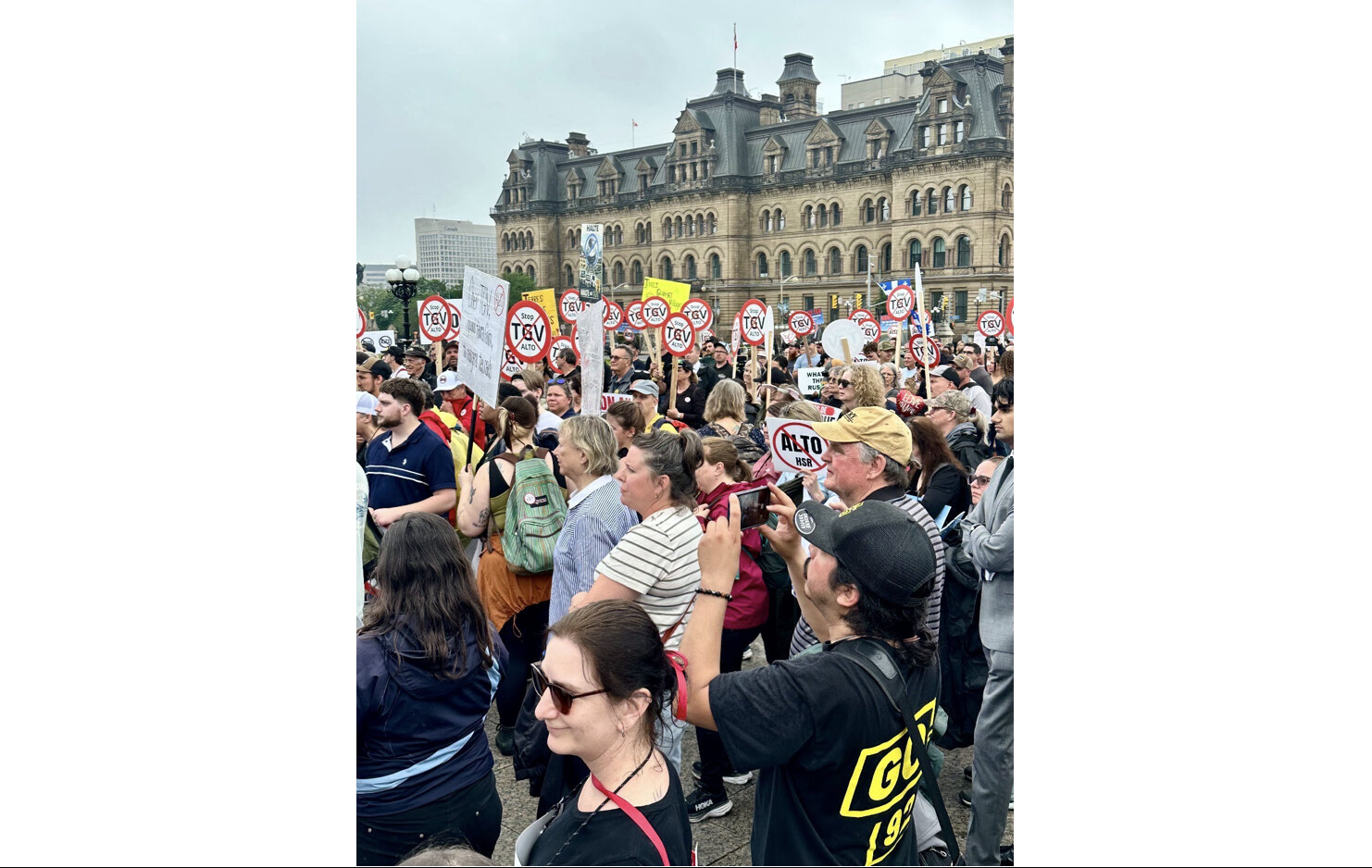
Roughly a thousand farmers and rural landowners rallied outside Parliament on June 10 to demand a moratorium on Alto's high-speed rail line, arguing the project would carve up Quebec and Ontario farmland with too little transparency, even as the Crown corporation behind it touts a tourism and economic windfall worth billions. Photo: Vincent Yergeau
Farmers and rural landowners take their Alto fight to Parliament Hill
Tashi Farmilo
Canada's flagship high-speed rail project ran into a wall of rural opposition on June 10, when close to a thousand farmers, landowners and supporters rallied outside Parliament in Ottawa to demand the government pause the Alto line until the people whose land sits in its path get clearer answers. The figure is the organizers' own estimate.
The demonstration was coordinated by local unions of the Union des producteurs agricoles, drawing producers from Mirabel, Argenteuil and Deux-Montagnes alongside a string of citizen groups from both Quebec and eastern Ontario, among them associations representing landowners near Belleville, Rideau Lakes and Tyendinaga Township. The UPA described the event as a peaceful gathering, with farmers and representatives from both provinces speaking at noon. Its stated purpose was to put the project's impact on agriculture and on affected municipalities in front of elected officials, from possible expropriations to the knock-on effects on neighbouring farms, businesses and natural areas.
The grievance at the centre of the protest is uncertainty. Robert Charron, a Mirabel municipal councillor, opposition leader and spokesperson for the anti-Alto group, frames the dispute as one of transparency and social acceptability rather than opposition to rail itself. He accuses the federal government of arrogance over the project's costs and its legislative approach, and faults Alto for withholding details on the route and on activities such as drone surveys. In his telling, the line lacks buy-in across Quebec, Ontario and among First Nations, and he points to the Mohawk community of Kanesatake as one example. Asked which municipalities and properties would be hardest hit, he said no one can yet say: "The lack of transparency from the Carney government and from Alto unfortunately makes it impossible to know."
The agricultural stakes, as the group sees them, are considerable. Charron describes the land in question as some of Quebec's most important farmland and maple groves, and notes that Mirabel accounts for a large share of dairy production in the region north of Montreal. Beyond outright expropriation, he warns that carving up properties would force farmers and residents to travel extra kilometres simply to reach fields cut off by the tracks, complicate the response times of emergency services, and weigh on people in ways that rarely make the official accounting. "A blind spot we haven't talked about enough is the mental health of these farmers and citizens," he said. The group's demand is blunt. "Impose a moratorium and go back and do your homework," Charron said. "This project is unacceptable in its current form. We won't be pushed around."
Alto and the federal government make a very different case, one built on national benefit. Alto, the Crown corporation established to develop, build and operate the line, points to a study it commissioned arguing the railway would be a major tourism driver. The corporation says the Quebec-to-Toronto corridor already draws more than a fifth of the country's domestic visitors and a large share of its international tourists, generating tens of billions of dollars in annual tourism spending. Under a scenario with moderate coordination between the rail project and the tourism sector, the study estimates the line could lift national GDP by roughly $1 billion and support more than 11,500 jobs along the route. Alto's strategy and development executive argued the project would reshape how people travel the corridor, pointing to France's experience, where high-speed rail helped turn Lyon into a stronger tourist destination when better access was paired with active promotion.
The corporation casts the line in sweeping terms, describing it as the largest infrastructure project in recent Canadian history and the country's first true high-speed rail network, with planned stations in Quebec City, Trois-Rivières, Laval, Montreal, Ottawa, Peterborough and Toronto. Trains are designed to run at up to 300 kilometres per hour across roughly 1,000 kilometres of electrified track, with construction on a first phase between Montreal and Ottawa expected to begin near the end of the decade. The project's estimated cost has been pegged between $60 billion and $90 billion, a price tag opponents seize on and proponents defend as an investment in generations of mobility and economic growth.
For the demonstrators, June 10 was a beginning rather than an endpoint. "This is only the beginning. The protest isn't an end in itself," Charron said, describing several strategies in the works with a Quebec-Ontario common front of citizens and farmers and in partnership with the UPA and the National Farmers Union. He signalled the coalition intends to make itself felt at the ballot box, vowing the common front would be "a player in the next provincial election campaign in Quebec."