
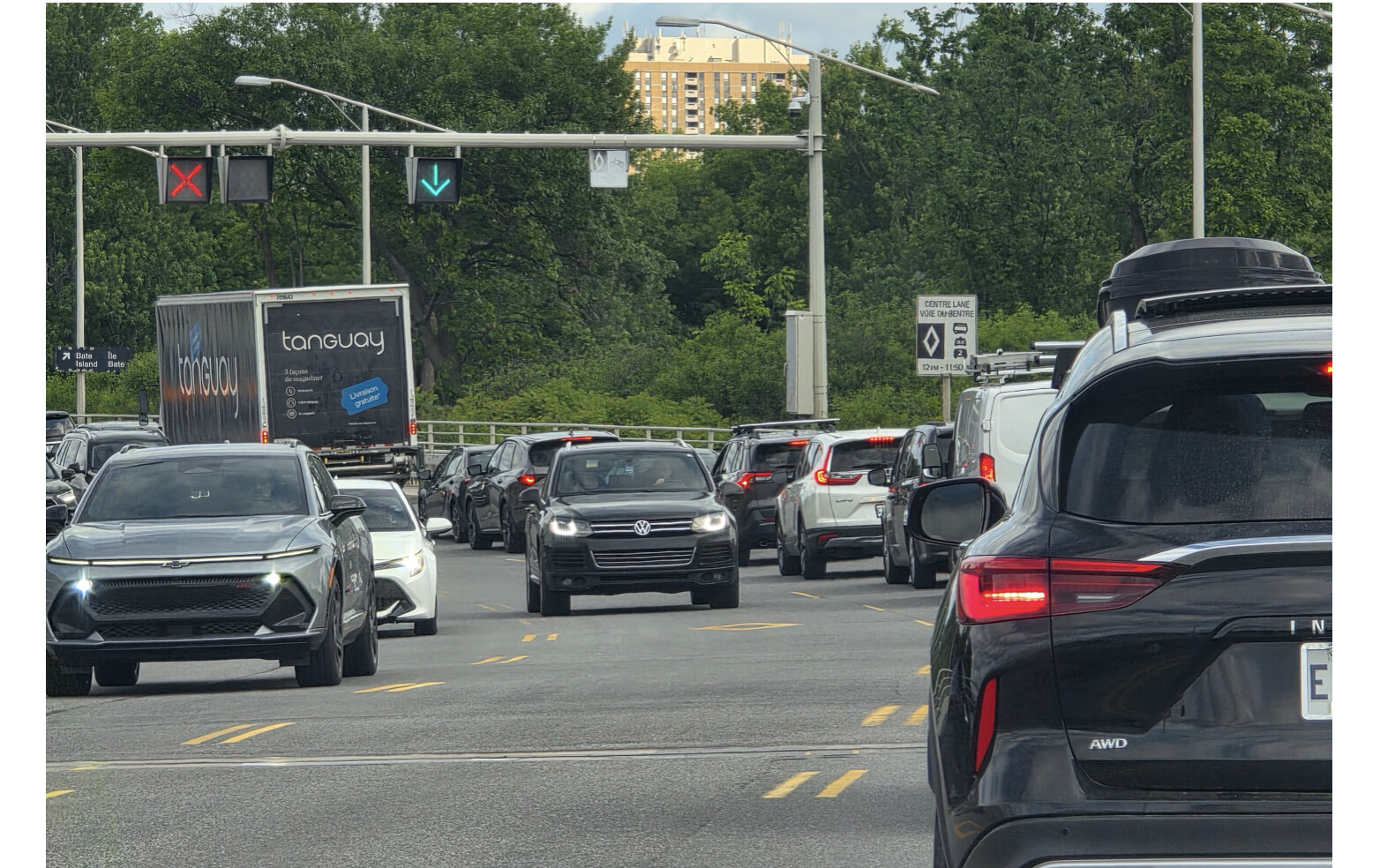
Gatineau commuters are being encouraged to swap solo car trips for transit, walking, cycling or carpooling this September as the Solo Car-Free Challenge, coordinated locally by MOBI-O, returns for its eighteenth year. Photo: Tashi Farmilo
Car-free challenge returns to Gatineau
Tashi Farmilo
The Solo Car-Free Challenge is back this September, and in Gatineau the month-long event will once again be steered locally by MOBI-O, the regional mobility centre based in the city. The campaign asks residents, employers and students across the Outaouais to trade solo car trips for the bus, walking, cycling, carpooling or working from home, and to log those trips in the Challenge's mobile app for points that translate into entries for prizes.
MOBI-O serves the Outaouais and Abitibi-Témiscamingue and is a member of the Network of Mobility Expertise Centres, or RCEM, which coordinates the Challenge province-wide. The event started in 2009 as a local effort in central Quebec and Mauricie before spreading across the province, and this fall marks its eighteenth edition.
The case for leaving the car at home is hard to wave off. In Quebec, roughly 43 per cent of greenhouse gas emissions come from transportation, and road transport alone accounts for 31.2 per cent of the province's total. That makes everyday driving one of the largest single levers an individual can pull on emissions, and it is exactly the behaviour the Challenge targets, one trip at a time.
The financial case is just as direct. Running a car is one of the steeper line items in a household budget, and the costs have been climbing. Average car insurance rates in Canada rose 14.4 per cent through the end of 2025, pushing the national premium to roughly $1,973 a year, while routine maintenance now runs an estimated $1,400 to $1,500 annually. That is before fuel, which CAA notes tends to be a driver's most expensive annual cost after depreciation. Each trip taken by bus, bike or carpool is one fewer paid for at the pump, the repair shop or the parking meter.
Myriam Nadeau, director general of the RCEM, frames the appeal as a low-pressure way to build new habits. "Taking the first step is not always easy," she says, adding that encouragement from a workplace or campus can be what convinces people to try a different way of getting around. She notes that some organizations keep going after September, putting longer-term sustainable mobility measures in place once the Challenge wraps.
Province-wide, the 2025 edition drew 3,747 participants and 232 organizations across Quebec, who together logged 1,726,684 kilometres of sustainable travel and avoided 301,189 kilograms of CO2 equivalent in emissions. The RCEM points to those figures as evidence that small shifts in daily travel can add up to measurable cuts in transportation-related greenhouse gas emissions.
For more information and registration: www.defisansauto.com